The Myth That a Policy Statement Explains Its Own Terms
Read a policy statement without mistaking headings or examples for firm promises, and trace which people, actions and conditions the wording actually covers.
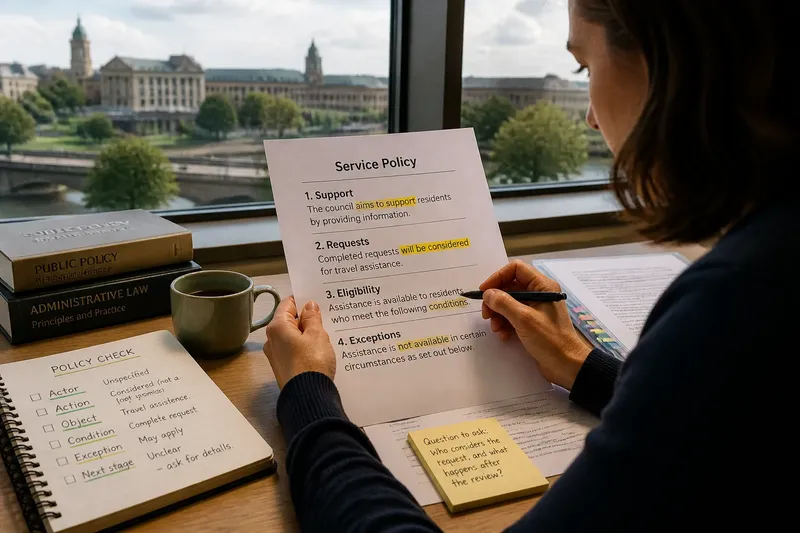
A heading can promise “Support” while the sentence beneath it only describes where to ask for information. Reading a policy statement carefully means tracking who must act, what they must do and which conditions apply—not treating a familiar term as the whole rule.
Separate the heading from the operative sentence
Headings help readers find a topic, but the sentence that sets out an action carries more weight. A section called “Eligibility” might explain an application route without stating who qualifies. Read the complete sentence and identify its subject, verb and object: who is responsible, what action is required, and what or whom the action concerns.
Then check whether the wording describes a firm duty, an option or an intention. “The council will provide an appointment” makes a different commitment from “the council may offer an appointment” or “the council aims to offer appointments”. Do not promote an aim into a promise, or downgrade a stated duty into a possibility.
Trace who acts and what happens next
Policy statements often hide responsibility in passive phrases such as “applications are reviewed” or “assistance will be offered”. Look for the named department, officer or service elsewhere in the passage. If none appears, note that the statement does not identify the actor; do not assume a particular team is responsible.
Follow the action through to its next stage. A sentence may say that a request is “considered” without explaining whether the next event is a decision, referral or further assessment. Look for linking words such as “after”, “subject to” and “unless”. They can show when an action happens and what might prevent it.
Check what conditions and exclusions change
A general statement may be narrowed by a condition later in the same paragraph. Look for words such as “if”, “only”, “where” and “except”. These terms can determine who is included, what evidence is required or when a process applies.
Read an exception alongside the main rule rather than treating it as a footnote. If the main sentence offers a service to residents and a later clause limits it to a named group, the limitation changes the practical meaning. Record the condition in plain language, but keep the policy’s exact wording beside your note.
Test whether examples define a boundary
An example illustrates a situation; it does not automatically set out every situation covered by the policy. Check whether the document says the example is exhaustive, or uses wording such as “including” to suggest that other cases may also fit. If the text does not say, do not infer a boundary from the example alone.
Say you are reading an invented council policy that says residents may request help with transport and gives a bus pass as an example. The starting information is that the policy names transport help but says nothing about other forms of travel. You check the sentence for “only” or “including”; imagine it says “including bus passes”, with no exclusion. Your note would say that a bus pass is expressly covered, while other transport help remains unspecified—not that the policy rules it in or out.
What should you check before relying on a policy statement?
Does “will” always mean the same thing?
Read the whole sentence and check whether a condition limits the commitment. “Will” signals a stated action, but a clause such as “if the application is complete” may define when that action applies.
Can a heading establish eligibility?
A heading can point to an eligibility section, but it does not establish the criteria by itself. Find the sentence that names who qualifies and note any conditions or exclusions attached to it.
What does a passive sentence leave out?
A phrase such as “the request will be reviewed” names an action but may omit the responsible person or body. Look elsewhere in the relevant section for the actor; if the policy never identifies one, preserve that gap in your notes.
When should you ask for outside advice?
If an unclear statement affects a service, decision or entitlement, ask the responsible office to explain the relevant wording and process. For significant legal or financial consequences, seek guidance from a suitably qualified professional rather than relying on a general explanation.
Make a record that leads to a decision
Use a short check of the sentence before drawing a practical conclusion. Each observation should lead to a decision; if the wording does not settle the point, choose a next action instead of filling the gap with an assumption.
- Actor: Check whether the sentence names who acts; if it does, record that body or person, but if it does not, look elsewhere in the section and mark responsibility as unspecified if still absent.
- Action: Check the verb for a duty, option or aim; if the statement says “will”, record the stated action subject to its conditions, but if it says “may” or “aims”, do not treat the action as a firm commitment.
- Object: Check what the action applies to; if the sentence names a person, request or service, keep that scope, but if it does not, find a linked provision or mark the scope as open.
- Condition: Check for “if”, “only” or “subject to”; if a condition appears, include it in your reading, but if none appears, do not invent one.
- Exception: Check for “unless”, “except” or a later limitation; if one narrows the rule, note the affected cases, but if no exception is stated, do not infer one from an example.
- Next stage: Check whether the text says what follows the action; if it names a decision or referral, record that outcome, but if it stops at “reviewed” or “considered”, ask what happens afterwards.
Turn an unresolved point into a precise question
When the wording leaves a practical gap, quote the sentence and ask about that specific gap. “Who reviews a complete request, and what happens after that review?” is easier to answer than “What does this policy mean?” Keep any written reply with the policy passage it addresses, since an explanation may concern a particular process or situation.
Imagine an invented service policy says, “Completed requests will be considered for travel assistance,” and gives no further detail. You begin with that exact sentence, note that it names completed requests but not the decision-maker or outcome, and check the nearby paragraph for an office or next step. If neither is named, you contact the service office and ask who considers the request and whether the statement describes an assessment or a commitment to provide assistance. The resulting answer can clarify the process; until then, your reading should not treat consideration as approval.
For a policy statement, the useful question is not only what a phrase sounds like, but what the sentence actually commits an institution to do. Track the actor, action and conditions first; where one is missing, ask about that element rather than turning a broad heading or example into a promise.