Mandate or Procedure: Two Different Jobs in a Public Institution
Mandate or procedure: learn to separate a public institution’s assigned purpose from its routine steps, and see what each tells you about a decision.

A public institution can follow its routine perfectly and still fail to serve its assigned purpose. To understand what happened, separate its mandate—the work it is meant to do—from its procedure—the steps it uses to do that work. Reading these as two different things helps you ask a precise question when a service or decision seems wrong.
Start by locating the institution’s mandate
Begin with the material that describes why the institution exists and what responsibilities it has. Depending on the body, that may be a law, a charter, a formal terms-of-reference document, or an official description of its responsibilities. Look for the institution’s own name and the duties assigned to it, rather than relying only on a general page about public services.
Write down the relevant purpose in plain language. Keep it narrow: identify the public need the institution is responsible for addressing and the kind of work it is expected to undertake. A mandate does not usually tell you every action an employee must take in a particular case. It sets the institution’s remit, or boundary of responsibility.
For instance, an agency may be responsible for assessing applications for a public service. That purpose does not, by itself, say which form to submit, who reviews it, or how a decision is communicated. Those details belong to procedure.
Find the procedure used for the work
Next, look for the operational material that explains how the institution handles the task. It might be a service guide, an application form, an internal process published for the public, or instructions supplied with a request. Note the actions and order it describes: what information is collected, who considers it, what checks take place, and how the outcome is passed on.
Keep the source and purpose of each document clear. A service page can tell you what a person should do, while a staff procedure can describe how a team processes the response. Neither should be treated automatically as a statement of the institution’s full legal or public remit. Where the answer depends on a law, official policy, product instructions or local rules, check the controlling source or ask a qualified professional where appropriate.
Imagine you are helping a neighbour who has applied for a housing support service. The institution’s mandate describes its responsibility for assessing eligible requests; its procedure says to submit an application and supporting documents for review. If the application is returned because a document is missing, that may be a procedural issue. If the office says it has no responsibility for the type of request at all, the question concerns its mandate.
Compare purpose and process without merging them
Put the two descriptions side by side. Ask whether the procedure appears to be a way of carrying out the stated purpose, then look for a specific point where they diverge. A difference in wording is not automatically a contradiction: a broad responsibility can be carried out through detailed, practical steps. The useful question is whether those steps support the assigned work or seem to leave a relevant part of it unaddressed.
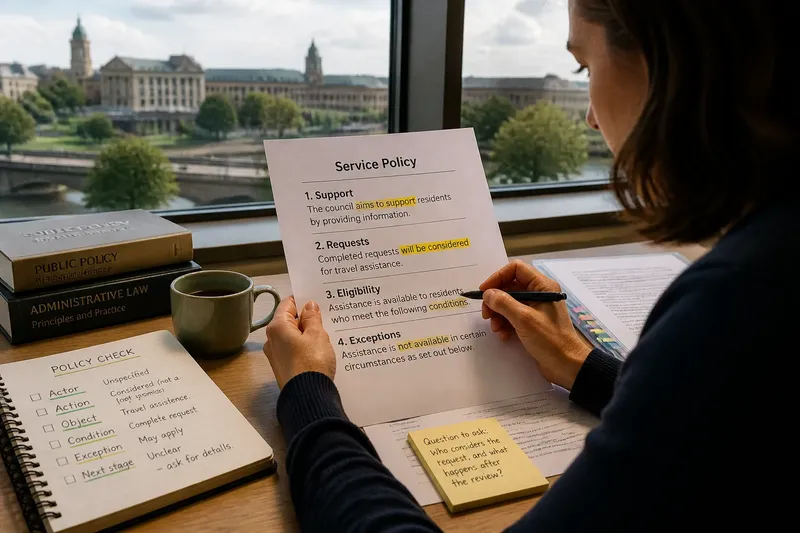
Use a simple comparison table in a notebook or document:
- Mandate: What responsibility is assigned, and to whom?
- Procedure: What action or sequence is expected?
- Connection: Which part of the procedure serves the stated responsibility?
- Gap: What part of the concern does neither source explain?
- Question: What would clarify the difference?
Keep observations separate from conclusions. “The guide requires a referral letter” is an observation. “The institution is not allowed to help without one” is a conclusion that may require another source. This distinction makes any follow-up easier to answer and less likely to turn a missing explanation into an unsupported accusation.
Check what kind of problem you are seeing
Classify the issue before contacting the institution. The distinction helps you direct a question to someone who can address it.
- Unclear mandate: The institution’s materials do not explain whether it is responsible for the matter. Ask which official document sets out its remit and which office handles this type of request.
- Unclear procedure: Its responsibility seems relevant, but the required steps, documents or decision route are not explained. Ask for the current public instructions and what action is expected next.
- Possible mismatch: A stated step appears to prevent the institution from carrying out a responsibility described elsewhere. Identify the two sources and ask how they fit together.
- Individual case concern: The general process is clear, but a particular decision or delay raises a concern. Ask about the reasons and review or complaint route that applies to the case.
Do not assume that an unfriendly outcome proves the mandate has been ignored, or that a written procedure settles every question about responsibility. A procedure can be consistently applied yet poorly suited to the stated purpose; conversely, an unfamiliar step may have a sound explanation that the public-facing material leaves out.
Ask a question that matches the issue
Contact the institution with a short, specific enquiry. Name the service or decision, identify the material you consulted, and state the point you cannot reconcile. Ask for an explanation rather than offering a conclusion on the institution’s behalf.
For example: “Your service description says the office assesses these requests. The application guide asks for a referral letter, which I do not have. Is there another route to assessment, or does the referral requirement define who the service can consider?” This wording separates the assigned work from the operational requirement and gives the recipient a concrete point to address.
If you are asking about an individual case, include only information needed to identify it and use the institution’s approved contact channel. Keep a copy of your question and the reply. If the response does not address the distinction, follow up by asking which source explains the institution’s responsibility and which source governs the step in question.
What should I read first when the sources conflict?
Should I start with the mandate or the procedure?
Start with the mandate to establish the institution’s assigned responsibility, then read the procedure to see how it handles the task. If a particular case is at stake, also check the instructions given for that service.
Can an institution change its mandate through a procedure?
A routine document does not, on its own, explain the authority for changing an institution’s remit. Ask what formal source establishes the responsibility and how the procedure is authorised.
Does following the procedure settle whether a decision was right?
It tells you whether the described steps were followed, not necessarily whether the institution had the right remit or whether the decision addressed the relevant issue. Those questions may need separate explanations.
Who can clarify a confusing document?
Ask the service team for operational guidance and the relevant public information or governance contact for the source of the institution’s responsibility. If the matter has legal consequences, seek advice from a qualified professional.
Keep the distinction useful
When you encounter the phrase mandate or procedure, treat it as a prompt to identify two separate answers: what the institution is responsible for, and how it carries out that work. Record the source for each answer, then frame your enquiry around the gap between them. That small discipline makes public explanations easier to assess and gives officials a clearer question to respond to.