From Noticeboard to Public Record: A Short History of Publishing Decisions
Public decision records have shifted from notices to searchable archives. Learn what each format preserves and how to trace a decision back to its source.
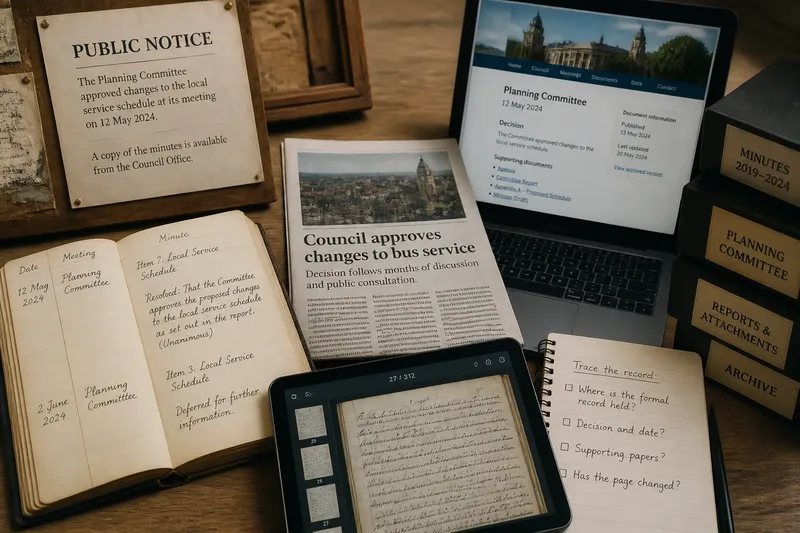
A notice fixed to a town hall board can tell a passer-by that a decision has been made; a dated file in an online archive can let a reader return to it later. Public decision records take different forms, and each makes some details easier to find than others.
This account follows six formats used to announce or preserve public business. It does not describe a single universal timeline: institutions and places have adopted and retained formats in different ways. The useful question is what each format lets a reader see, and what further record may be needed.
1. Posted notices bring information to a particular place
A public body may post a meeting notice or decision on a board at a town hall, courthouse or other designated location. People who visit that place can encounter the information without searching a publication or archive.
The limits are practical. Readers need to know where and when to look. A notice may be replaced, removed or damaged, and its short text may point to a decision without explaining the discussion or documents behind it.
Imagine a resident sees a notice saying a committee has approved a change to a local service schedule. The notice names the outcome but gives no link or reference to the meeting record. If the resident returns after the notice has been replaced, they may need to contact the committee to locate the minutes.
2. Registers preserve an institution’s recorded sequence
Minutes and registers record public business as entries associated with meetings or other proceedings. A reader may be able to follow a matter through a sequence: an item was raised, deferred, amended or recorded as decided.
Finding an entry can take work. Readers may need the institution’s name, a date, a meeting title or an index. Handwriting, abbreviations and inconsistent descriptions can make a register difficult to search, and an official entry is not necessarily a full transcript of every exchange.
A register is useful for tracing what the institution formally recorded. It should not be mistaken for a complete account of every view expressed or document considered.
3. Newspapers carry decisions beyond official buildings
Newspapers can bring accounts of public decisions to readers who do not visit an institution’s offices or archive. A report may add context, identify people involved or explain why an issue matters to the community.
A news report is an edited account, not the institution’s full formal record. Space and editorial choices shape which details appear. A report may describe a debate or result while omitting technical papers, procedural details or quieter concerns.
Use the newspaper account to understand how a decision was reported to readers, then consult minutes or the formal decision document for the institution’s record. Comparing the two can clarify both the public account and the official entry.
4. Scans make pages available without making every word searchable
A scanned document lets readers view a page without travelling to the room where a volume is held. The image can preserve layout, handwriting, marginal notes and marks that a plain-text transcription may not show.
A scan is not automatically searchable text. Readers may have to open files one by one or move through a long document to locate an entry. Optical character recognition can help with printed pages, but unusual names, stains, columns and older type can produce errors. A search with no result does not establish that a record is missing.
Check the archive catalogue as well as the scan. A clear title, date and institution name make it easier to identify a page and ask for the right source. Digitised collections may cover some records while others remain available only through the repository.
5. Websites connect decisions to supporting documents
An institutional website can publish a decision alongside agendas, minutes, reports or notices. Links make it possible to move from a short announcement to material that gives it context.
Web pages can also change. An institution may correct, replace or remove a page, while links to supporting files may stop working after a site redesign. Publication dates, revision notes and preserved versions help readers distinguish current information from an earlier account.
Look for clear labels that distinguish an explanatory summary from a formal decision document. If a page links to an agenda or report, check that the link opens the intended file and that the document relates to the same meeting or decision.
6. Structured data helps readers compare records
Structured data organises records into fields such as date, department, location or decision type. Readers can filter entries and compare records more readily than they can by turning through separate pages.
That convenience depends on clear, consistent terms. If similar departments appear under different names, a search may miss entries. If a field’s meaning is unclear, a table can look precise while leaving readers unsure what its categories mean.
Use a dataset to locate or compare records, then follow its source links to the fuller documents. A table may identify a decision and its date while leaving the reasons, discussion or supporting evidence in minutes or reports.
How can readers trace a public decision record?
Where is the formal record held?
Look for minutes, a formal decision document or the institution’s archive rather than relying only on a news report or short web summary. If the source is unclear, ask the relevant records office where the official entry is held.
Can you identify the decision and its date?
Check for the responsible body, meeting or decision date, and a document title or reference. If any detail is missing, use the information available to ask the institution to identify the correct record.
Are the supporting papers available?
Look for an agenda, report, attachments or minutes connected to the decision. If the page gives only an outcome, request or search for the papers that show what the body considered.
Does the online page show whether it changed?
Look for a publication date, revision note or archived version. If no history is provided and the wording matters, contact the records office to ask whether an earlier version can be consulted.
Public decision records depend on a clear route back
Notices make information visible at a particular place; registers preserve an institutional sequence; newspapers provide edited public accounts; scans show pages; websites connect documents; and structured data supports comparison. These formats are not a single sequence adopted everywhere, and none makes every part of a decision equally easy to revisit.
For anyone tracing a public decision record, start with the source, date and responsible body, then follow links or catalogue references to the fuller material. If the record is incomplete or hard to locate, a precise enquiry to the institution is more useful than relying on a search result alone.